Featured story
Omarchy Is a Linux You Can Install Today. Kora Is Built Around the Model.
David Heinemeier Hansson's opinionated Arch and Hyprland setup is a finished daily driver you can install this afternoon. Kora, unveiled Tuesday, rebuilds the desktop around local inference — and will not reach PCs until 2027.
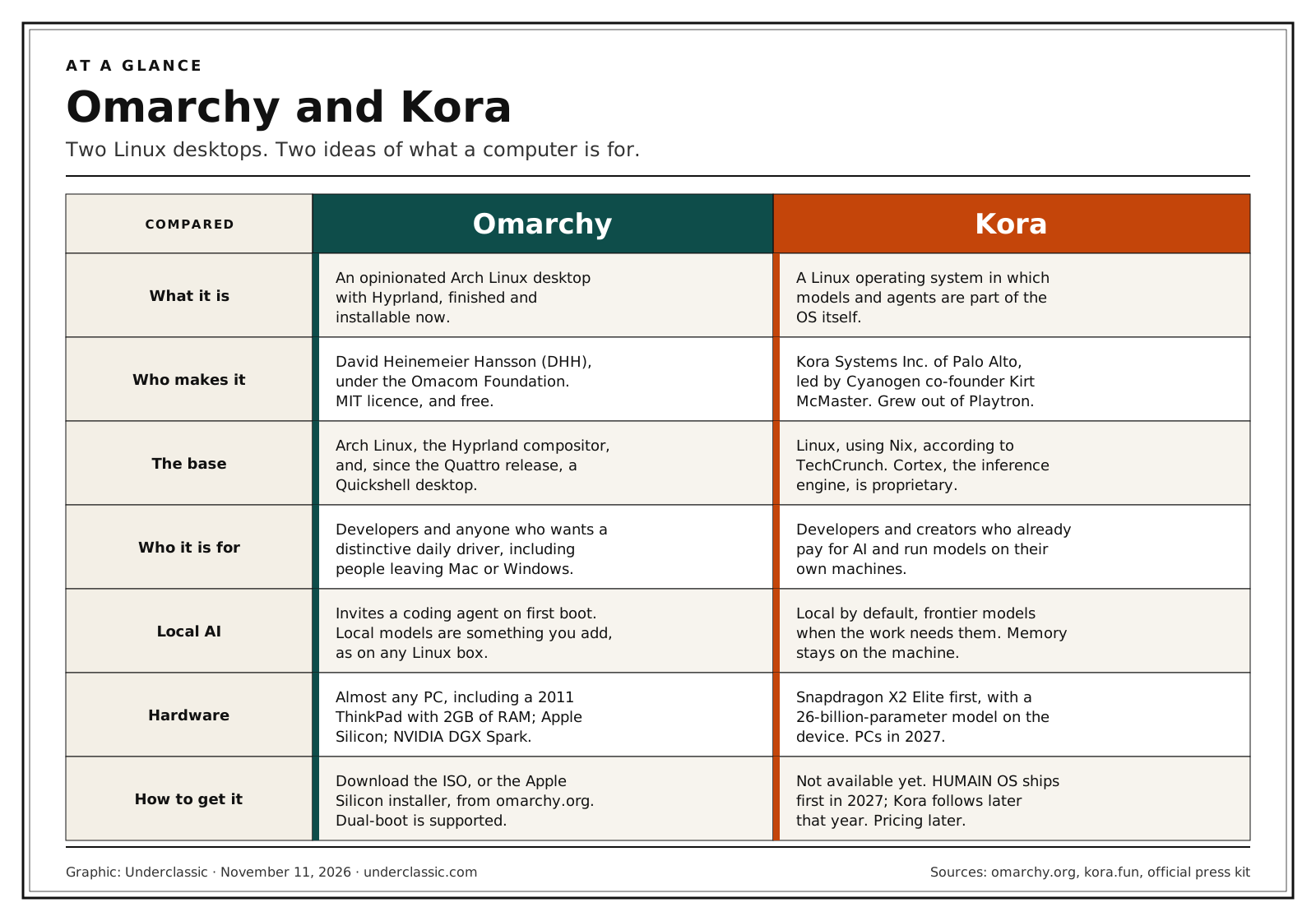
Linux, this week, is being asked to be two different things at once. One is an opinionated desktop you can write to a USB stick this afternoon. The other is a ground-up operating system in which models and agents are not apps you install, but part of the machine itself. They share a kernel. They do not share a thesis, a timetable, or much else.
Omarchy is the first of those ideas, and it is already here. David Heinemeier Hansson, the creator of Ruby on Rails, published it on June 26, 2025, as what he called an opinionated setup of Arch Linux and the Hyprland tiling window manager — “exactly the same setup that I now run every day.” It is now a full distribution, under the Omacom Foundation. The current installer on omarchy.org is version 4.5. The desktop is still Hyprland; since the August 2026 “Quattro” release, the bar, launcher and lock screen live in a single Quickshell process.
Oma, Hansson likes to say, is for omakase: the chef chooses. The installer asks a handful of questions and hands back a finished environment. It will dual-boot beside Windows, run on a 2011 ThinkPad with 2 GB of RAM, and sit next to macOS on Apple Silicon M1, M2, M3 and Neo MacBooks. Preliminary ARM builds cover NVIDIA's DGX Spark and Snapdragon N1X laptops. The project is released under the MIT licence, as the source repository states, and is free. Hansson has said it will stay that way.
It is also, in the project's own marketing, an “agentic” Linux. On first boot, Omarchy invites you to set up a default coding agent, and it ships skills so that agent can inspect a crash or restyle the desktop. That is not the same as making local model inference a system service. You can run open-weight models on Omarchy the way you can on any well-equipped Linux box, and our Open-Source AI Guide and buyer's guide are there for that work. The operating system will help an agent move around the machine. It will not, by itself, schedule a language model across the silicon or keep a memory store the whole desktop can see.
Kora wants that job. Kora Systems Inc., a Palo Alto company that began as Playtron and shipped a Linux gaming system called GameOS, unveiled the new desktop on Tuesday. Chief Executive Kirt McMaster, a Cyanogen co-founder, said in the company's press kit that the team has been building on that foundation since November 2025. The official site, kora.fun, calls it “The Operating System for Intelligence.” As SiliconANGLE reported, and as we noted in today's issue, an inference engine named Cortex pools the processor, graphics chip, neural unit and other machines on the local network, and treats them as one computer. Local models run on the user's silicon by default; frontier models are pulled in for heavier work. That is split inference, built into the OS. In its Q&A, the company projects that about 70 percent of the model calls it manages will run locally in 2027.
The desktop is different, too. Folders and apps give way to what Kora calls neural workspaces, sandboxes arranged around a task, with a file system that indexes documents by meaning. Memory and context, the company says, stay on the local machine unless the user authorizes a cloud call. A joint release with Qualcomm says Snapdragon X2 Elite PCs can run a 26-billion-parameter language model entirely on the device. Cortex and the desktop interface are Kora's own technology and are not open source, McMaster told TechCrunch; Linux and Nix underneath are. TechCrunch and WIRED also reported that the system is intended to run on existing Intel- and AMD-based PCs; Kora's own fact sheet, for now, emphasizes Snapdragon-powered machines in 2027.
None of that is for sale yet. Kora comes to PCs in 2027. The first OEM machines to pair a Linux desktop with Snapdragon X2 Elite will run HUMAIN OS, an enterprise system Kora is co-developing with HUMAIN; Kora itself follows later that year. The company's Q&A says pricing and the business model will be shared closer to launch. TechCrunch reported that McMaster described the desktop OS as expected to be free to use, with revenue from subscriptions that bundle models and agentic services. Until those terms are published, you cannot install Kora today, or know what it will cost.
Which should you use?
If you want a distinctive Linux desktop today — finished, free, and open source, on hardware you already own, including a machine from the buyer's guide — Omarchy is the one that exists. If you want an operating system that treats local models as a default system service and rents the frontier only when the work requires it, Kora is the clearer statement of that idea. It is also a statement. You can already build that bargain on Omarchy, or on any other Linux, with the models in our open-source guide. Kora asks you to wait a year and let the operating system do that work. Whether the wait is worth it will depend on what ships in 2027, and on whether the models still run locally when they do.
A standalone Underclassic feature. Daily briefing: underclassic.com. Related: Issue 101, the Open-Source AI Guide, and the buyer's guide. Sources: omarchy.org, Hansson's June 2025 announcement, the Omarchy repository, kora.fun, Kora's press kit, SiliconANGLE, and TechCrunch.