Featured story
What the Midterms Actually Turned On
Democrats took the House and Senate on November 3. The economy was the strongest current in the results. Three other fights — over AI data centres, the war in Iran, and Israel and Gaza — each left a mark. None of them, on the evidence, tells the whole story by itself.
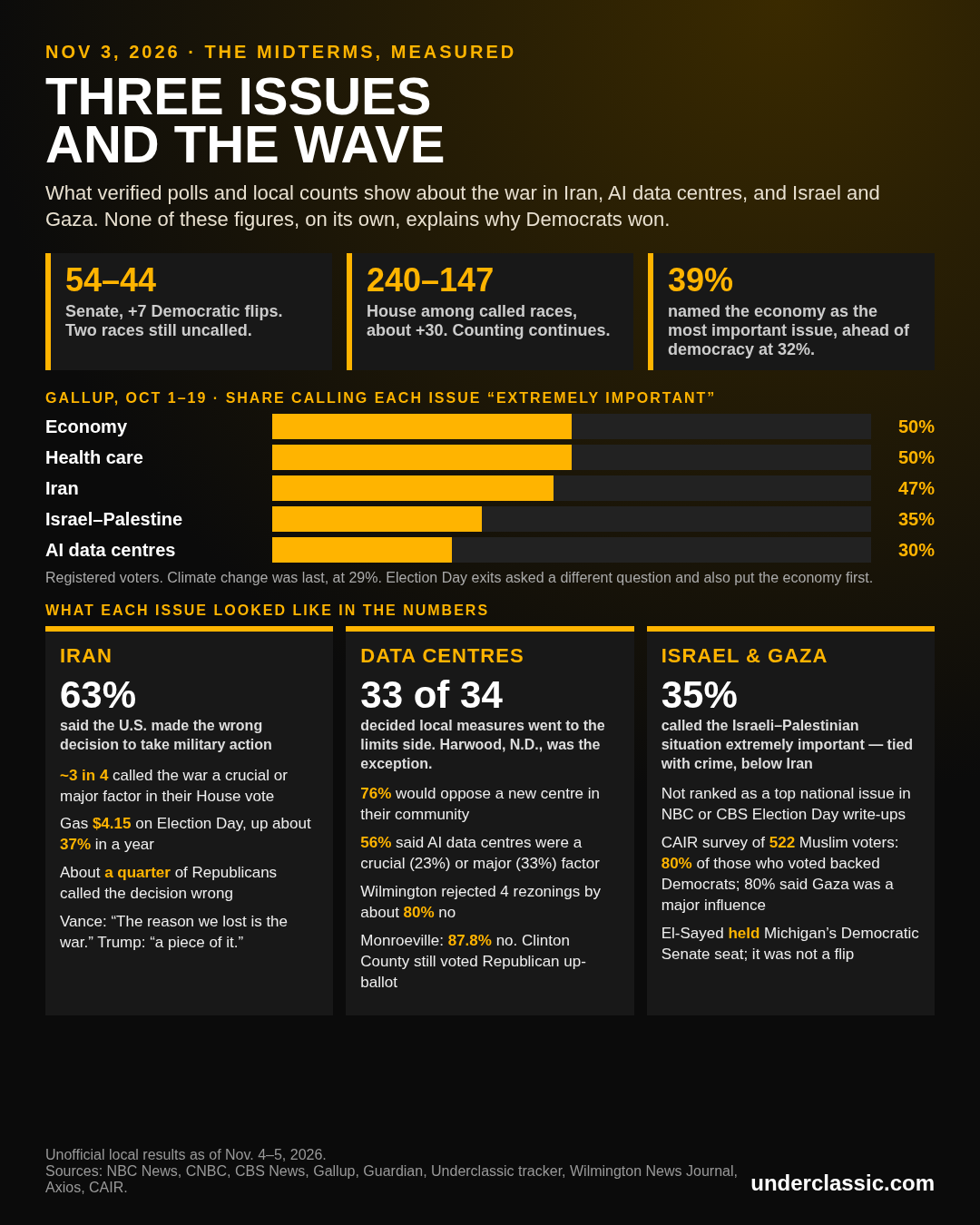
Two nights later, the scoreboard is clear enough. Democrats flipped seven Republican Senate seats, in Iowa, Kansas, Maine, North Carolina, Ohio, South Carolina and Texas, and built a House majority that was still growing as later ballots were counted. The Guardian's tally early Thursday showed them ahead 54 to 44 in the Senate, with two races uncalled, and 240 to 147 in the House among seats already projected, a net gain of about thirty. Ballotpedia, working from earlier returns, put the House pickup at eighteen or more. Either way, it was a wave.
What carried it is less mysterious than the commentary around any single issue. In the NBC News exit poll, 39 percent of voters named the economy as the most important issue facing the country; the state of democracy was next, at 32 percent. Three-quarters said the economy was in rough shape, and 65 percent said President Trump's policies had made it worse. Forty-three percent said one reason for their vote was to express opposition to him. The Associated Press described a rebuke built on high prices, the Iran war and concerns about government corruption.
The same day, voters in towns across Ohio and a handful of other states weighed data centres. The country was living with a war against Iran that began in late February and had lifted the price of gasoline, and a smaller but intensely motivated set of voters treated Israel and Gaza as a first-order question. The question now is what can actually be shown about the mark each one left.
The war in Iran
Of the three, the war reached the most voters, and it is the hardest to separate from the cost of living that dominated the night.
Sixty-three percent of voters in the NBC poll said the United States had made the wrong decision in taking military action against Iran, including a large majority of those who backed Democrats for the House. In the CNBC Voter Poll, a collaborative survey of about 100,000 interviews, nearly three in four said the war was a crucial or major factor in their vote for Congress. CBS News found the conflict less decisive than the cost of living, but still unpopular, including among about a quarter of Republicans. The people most worried about paying for gas were the most likely to say the attack had been a mistake.
That link is not abstract. Drivers paid about $4.15 for an average gallon on Election Day, the highest of any midterm or presidential election day since at least 2000, according to AAA figures cited by CNBC, after prices rose about 37 percent over the year as the conflict disrupted the crude trade. Mark Zandi of Moody's Analytics estimated that higher prices for gas and other energy had cost the average household nearly $1,230 since the war began.
Vice President JD Vance did not treat it as a side issue. "The reason we lost is the war," he wrote on X the next day, citing an unnamed pollster who told him that voters who left Republicans wanted the war ended, more attention to living costs, and a change in the United States' relationship with Israel. President Trump, in a Wall Street Journal interview quoted by NBC News, called Iran "a piece of it" and said he would have done it again.
A pre-election Gallup survey conducted October 1 through 19 had already placed "the situation in Iran" near the top of the list: 47 percent of registered voters called it extremely important to their congressional vote, behind only the economy and health care at 50 percent each.
What the public record does not yet support is a clean list of seats that flipped solely because of Iran. The seven Republican Senate seats that changed hands, according to Ballotpedia, were Josh Turek over Ashley Hinson in Iowa, Adam Hamilton over Sen. Roger Marshall in Kansas, Troy Jackson over Sen. Susan Collins in Maine, Roy Cooper over Michael Whatley in North Carolina, Sherrod Brown over Sen. Jon Husted in Ohio's special election, Annie Andrews over Sen. Darline Graham in South Carolina, and James Talarico over Ken Paxton in Texas. They were won in a climate saturated by prices, disapproval of the president, and the war at once. Isolating the war from gas prices, or from Trump's 38 percent approval rating in the NBC poll, would require finer data than the national exits provide. The honest reading is that it amplified an affordability revolt already underway, and that Republican leaders, including Vance, have treated it as a central reason they lost.
AI data centres
Data centres produced the clearest local results of the night and a more complicated partisan story than the national commentary suggests.
On the measures themselves, the pattern was lopsided. Underclassic's tracker, drawing on unofficial counts compiled by Data Centers on the Ballot, now shows the side seeking limits won 44 of 45 decided contests among 47 measures tracked, with two still being counted or canvassed and the limits side ahead in each. The only decided win for the construction side was in Harwood, North Dakota, where voters rejected a charter amendment requiring review before large industrial projects, 325 to 105. Election-night counts as of 5:50 a.m. Eastern on November 4 had the limits side winning 33 of 34 decided contests, a split Stateline also reported that night. Ballotpedia's list, cited by CNBC and Axios, counted 41 related measures in ten states, 21 of them in Ohio.
The margins in some of those towns were not polite. In Wilmington, Ohio, voters rejected four city ordinances that would have rezoned nearly 546 acres from rural residential to light industrial beside Amazon Web Services' planned campus at 1488 U.S. 68 South. The unofficial Clinton County counts, reported by the Wilmington News Journal, were 2,885 to 739; 2,886 to 732; 2,887 to 724; and 2,909 to 716 — about four to one against in each case. In the village of Monroeville, an advisory measure that would have allowed data-centre development failed 394 to 55, or 87.8 percent no. In Ashville, voters overturned a resolution tied to an EdgeConneX project, 1,469 to 331, about 82 percent against. Grove City's Issue 28, which requires a public vote on large projects that use large amounts of water or land, was leading 54.6 percent to 45.4 percent in the November 4 unofficial count and was reported by Axios on November 5 as having passed with 55 percent.
Nationally, that opposition showed up in the exits without rising to the top of the issue list. Seventy-six percent of voters in the NBC poll said they would oppose building a data centre in their community. Asked how important "AI data centers" were to their congressional vote, 23 percent called them crucial and 33 percent a major factor — 56 percent in all — according to figures from that poll reported by Data Center Dynamics. That still trailed government corruption, the cost of living and the Iran war. Gallup, before the election, ranked construction of AI data centres last but one among eleven issues, with 30 percent calling it extremely important.
Where the issue entered candidate races, it did so most visibly in Ohio and Texas, and even there it was one argument among several. CNBC reported that Brown had cast Husted as "the face of data centers," and CBS wrote that Ohio voters who opposed construction in their community voted for Brown. Democrat Amy Acton, who defeated Republican Vivek Ramaswamy for governor, supports what CNBC described as a "conditional moratorium" requiring data centres to cover their utility costs and build with union labour. In Texas, Gina Hinojosa defeated Gov. Greg Abbott after campaigning for a pause. "When I am governor I will issue a moratorium — a ban — on all data center approvals until laws can be passed by the Legislature to protect Texans," she said in an October 22 video quoted by the Texas Tribune. Abbott had earlier called Texas the "epicenter of AI development" and later imposed his own temporary freezes on environmental permits and grid connections.
It does not follow that every town that voted against a data centre also voted Democratic. Clinton County, home to Wilmington, rejected those four rezonings and, on the same ballot, gave Husted 10,056 votes to Brown's 4,242 and Ramaswamy 10,253 to Acton's 4,465, according to the News Journal's unofficial canvass. The local revolt was real, and it was not a party-line one. Among voters who called data centres a crucial factor in the national poll, Data Center Dynamics reported, 67 percent were Democrats and 30 percent were Republicans. Opposition at the property line crossed party; intensity in a congressional vote leaned Democratic. Data centres were a powerful local issue and a useful argument for Democrats in Ohio and Texas, not a hidden switch that turned Congress by itself.
Israel and Gaza
Israel and Gaza mattered a great deal to some voters and much less, in the national numbers, than the war in Iran or the price of groceries. That gap cuts against both the claim that the issue decided the midterms and the claim that it decided nothing.
In Gallup's October survey, 35 percent of registered voters called "the Israeli-Palestinian situation" extremely important to their vote, tied with crime and well behind the economy, health care and Iran. Democrats were more likely to say so (47 percent) than independents (33 percent) or Republicans (25 percent). The NBC and CBS national write-ups of Election Day did not present Israel and Gaza as a top-ranked national issue.
Among Muslim voters, the picture was different. A CAIR and CAIR Action exit survey of 522 self-identified Muslim registered voters, conducted November 2 through 4 and weighted, found that 80 percent of those who cast a ballot said they had primarily voted for Democrats, compared with 6 percent for Republicans. Eighty percent said what the survey called "the genocide in Gaza" was a major influence on their vote. The sample is specialized and modest in size, and CAIR is an advocacy organization; the numbers describe that survey's respondents, not the entire electorate.
The most closely watched race in which the issue was unavoidable was Michigan's Senate contest, and it was a Democratic hold, not a flip. Abdul El-Sayed, an epidemiologist and former public health official, defeated former Rep. Mike Rogers and will succeed retiring Democratic Sen. Gary Peters. He is the first Muslim elected to the Senate. He has described Israel's campaign in Gaza as a genocide, a charge the Israeli government denies, and a group affiliated with the American Israel Public Affairs Committee spent more than $30 million in an unsuccessful effort to nominate Rep. Haley Stevens instead, NBC News reported. Stevens later endorsed Rogers. The Guardian reported that El-Sayed won a majority of Jewish voters in Michigan, according to exit polls, and that J Street's polling found 72 percent of Jewish voters nationwide backed Democrats, even as Republicans gained share among Jewish voters compared with 2024.
Those results show an issue that has rearranged fights inside the Democratic Party more clearly than it can be shown to have peeled large numbers of Republican seats. Ballotpedia noted that candidates endorsed by the Democratic Socialists of America won seven of the ten House races they contested, with three still uncalled; many of those contests were in districts the party already held. Vance's secondhand list of reasons some Republican voters defected did include changing the U.S. relationship with Israel, but that claim comes from an unnamed pollster, not from a published national exit question ranked alongside Iran or the economy.
If the question is whether Israel and Gaza tipped the midterms toward Democrats, the evidence is thinner than headlines that have treated the night as a referendum on the alliance. The issue helped shape who Democrats nominated and helped mobilize Muslim voters who, in CAIR's survey, were already breaking heavily Democratic. It was central to a high-profile Senate hold in Michigan. It does not, on the numbers now available, explain Kansas, Iowa, South Carolina or the broader House map.
What holds up
The midterms were a verdict on a presidency, a set of prices, and a war that made those prices worse. Data centres gave that verdict a local address, in Wilmington and Ashville and Grove City and dozens of other places, and they featured in Democratic campaigns that won in Ohio and Texas without converting every anti-data-centre precinct into a Democratic one. Israel and Gaza sorted the Democratic coalition and one Senate race in Michigan more than they can be shown to have sorted the country.
None of that makes the three issues small. It makes them distinct. The mistake, two days later, would be to flatten them into a single story about why Democrats won.
A standalone Underclassic feature. Daily briefing: underclassic.com. Related: data centers on the ballot.