Underclassic rss archive buyer's guide
Permanent copy of issue 82. Today's issue is always the front page.
Previous issue | This week | archive
Meta reported negative free cash flow of $2.12 billion for the third quarter after spending $34.91 billion on capital projects, and its board approved a new class of non-voting shares that the company says it can use to raise capital. Investors answered on Thursday by selling Meta and the wider AI trade, while in Britain a taskforce including Nvidia, Microsoft and Cisco told ministers they have about 12 months to win public consent for data centers before opposition threatens construction. On the desk side, Recursive released Flint, an open coding model of 40 billion parameters that activates 2.5 billion per token and is built to run on a laptop.
Date: 2026-10-23
Updated: 2026-10-23 06:30
Status: LIVE
Broadcast
Meta's quarter answers a question investors have been asking all year: what happens when the spending outruns the cash. The answer is a share class without votes, created so the company can sell stock to keep building. Thursday's sell-off in Meta, Nvidia and the chip makers shows that the market will fund the clusters, but at a price and with less patience than before. In Britain the builders now concede that public consent is the scarce input, and they are offering councils money for it. Recursive's Flint points the other way, putting a serious coding model on a laptop with no meter running.
Watch
Stories
Meta Platforms reported third-quarter revenue of $64.60 billion, up 26 percent, but capital spending of $34.91 billion left free cash flow at negative $2.12 billion. Its board approved a new class of publicly listed, non-voting Class C shares from January 2027 for capital raising, staff pay and acquisitions, and Reuters reported that the stock fell 7 percent on Thursday.
-- One of the largest builders of AI data centers can no longer pay for them from the cash its advertising business produces, and has created a share class designed to raise more. The central build-out continues, but it now rests more heavily on investors' willingness to keep funding it.
2026-10-21 / Meta Investor Relations / chip / central / #meta-turns-cash-negative-and-creates-non-voting-
The Sovereign AI Leadership taskforce, a group including Nvidia, Microsoft and Cisco, has told the British government it has roughly 12 months to build a compact that earns public consent for data centers before US-style opposition takes hold, The Guardian reported on Thursday. The group wants councils that host data centers to keep more tax revenue and receive contributions scaled to the size of each site.
-- The companies themselves now say that electricity costs and distrust of their promises could stop permitted projects in Britain, as they have in parts of the United States. Every site that must buy local consent becomes slower and more expensive to build.
2026-10-22 / The Guardian / energy / local / #ai-firms-tell-uk-ministers-they-have-a-year-to-h
Texas Instruments reported third-quarter revenue of $6.06 billion, up 28 percent from a year earlier, and net income of $2.43 billion, with chief executive Haviv Ilan citing continued broad growth in industrial, automotive and data center markets. The company forecast fourth-quarter revenue of $5.80 billion to $6.30 billion.
-- Every AI server needs power-management and analog chips as well as processors, and demand for those humbler parts is now lifting one of the largest makers of ordinary semiconductors. It shows how far the spending on clusters reaches through the supply chain.
2026-10-21 / Texas Instruments / chip / central / #texas-instruments-lifts-revenue-28-percent-with-
Recursive, the start-up led by Richard Socher, released Flint, a mixture-of-experts coding model with 39.8 billion parameters that activates about 2.5 billion per token, under the Apache 2.0 licence. The company says it runs on Macs with M4 Pro, M5 Pro or M5 Max chips through its own engine and on tools including llama.cpp and Ollama, and its INT4 build for Apple Silicon occupies about 22.6 gigabytes.
-- Coding agents are among the heaviest users of paid cloud models, and a capable model that fits on a well-equipped laptop lets a developer keep code and costs at home. Its benchmark scores are the company's own and still need independent checking.
2026-10-21 / Recursive / efficiency / local / #recursive-releases-an-open-coding-model-built-to
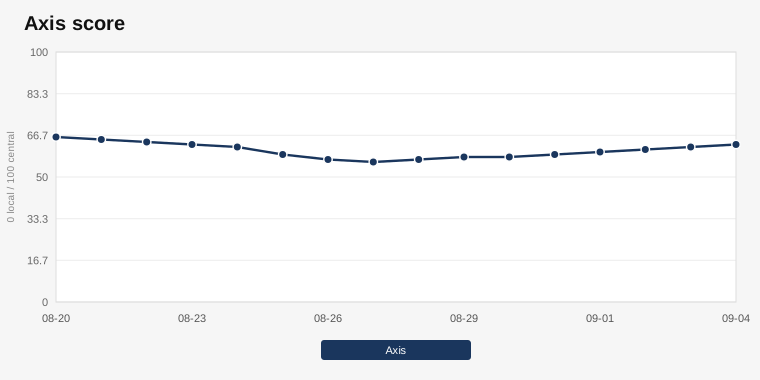
Axis
local [########################------] central
Score: 81
clusters still winning
down 1
Meta is still spending at a record pace, but it now needs outside money to do so, and the market's reaction on Thursday shows how much the central build-out depends on investors' patience. Texas Instruments' strong quarter confirms demand for data center parts, while British opposition to new sites and Recursive's laptop coding model each take a little from the cluster's lead, so the score eases to 81.
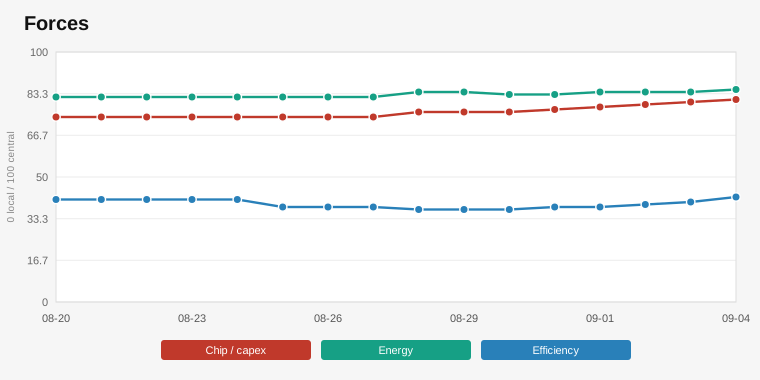
Forces
| Force | Meter | Score | Pull | Note | ||
| CHIP / CAPEX |
|
95 | central | Meta spent $34.91 billion on capital projects in the quarter and kept a 2026 range of up to $145 billion, and Texas Instruments reported revenue up 28 percent to $6.06 billion with growth in data center sales. | ||
| ENERGY |
|
98 | central | An industry taskforce including Nvidia, Microsoft and Cisco told UK ministers they have roughly 12 months to agree a compact with communities before US-style opposition to data centers takes hold in Britain. | ||
| EFFICIENCY |
|
70 | mixed | Recursive's open Flint coding model activates about 2.5 billion of its 39.8 billion parameters per token, and its INT4 build for Apple Silicon occupies about 22.6 gigabytes. |
Line charts (0=local 100=central 2026-10-06 to 2026-10-23)
Market overlay (2026-09-24 to 2026-10-23)
Latest: BTC $81,635 / hashrate ~1055.33 EH/s / token markers avg $5.2583/M / axis 81. These lines are different units. We compare timing, not dollars-to-hashrate.
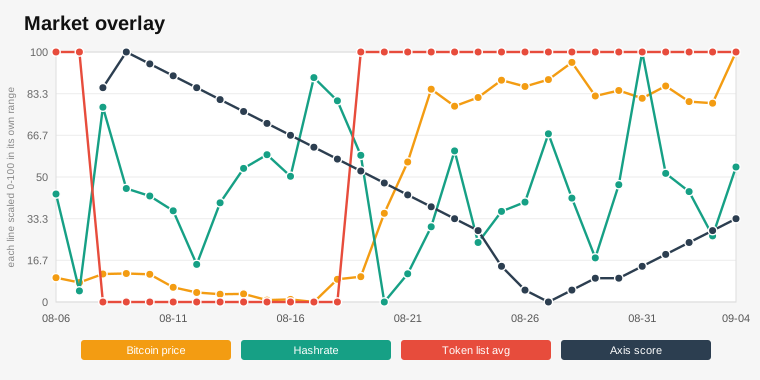
Not shown: GPU cloud $/hour, hub electricity, miner hashprice, or lab cost per token -- none of those are a clean public feed.
Power and list prices
BTC $81,635 / hashrate ~1055 EH/s. List-price gap (not a subsidy %): 123.1x list gap (blended) Mercury 3 -> Claude Fable 5.1 ($0.16/M to $20.00/M). (mempool.space + Coinbase/CoinGecko)
Marker prices (USD per 1M tokens; verified 2026-10-22; blended = (3*input + 1*output) / 4; -- = open/self-host or no single public list)
| # | Model | Org | CC | Weights | Tier | In | Out | Blend |
| 1 | Claude Sonnet 5 | Anthropic | US | closed undisclosed |
workhorse | $2.00 | $10.00 | $4.00 |
| 2 | GPT-5.5 | OpenAI | US | closed undisclosed |
flagship | $5.00 | $30.00 | $11.25 |
| 3 | DeepSeek V4.1 Flash | DeepSeek | CN | open ~284B total / ~13B active (MoE) |
commodity | $0.30 | $1.20 | $0.53 |
If useful, support the broadcast.
bc1qfs3yw5qlq8sxs50crzh3g84ug27gvww9npu85n

Subscribe
$ echo you@email.com | underclassic --subscribe
One email per issue. No tracking pixels, no filler.
home | rss | page 2 | page 3 | archive | models | buyer's guide | subscribe | data | board | mcp | llms.txt