Underclassic / tracker / updated daily
The glyphosate tracker
Washington declared the weedkiller a national-defense priority, the Supreme Court narrowed Roundup lawsuits, and MAHA voters say the betrayal cost Republicans the midterms. This page follows the law, the science and the fight to restrict glyphosate, with every claim sourced and every contested finding labeled.
Published 2026-11-09. Updated 2026-11-11. Every claim links to its source; contested findings are labeled as such.


| Feb 18 2026 date of the Defense Production Act order naming glyphosate critical to national defense | 7-2 Supreme Court vote in Monsanto v. Durnell barring failure-to-warn claims over the EPA-approved label | 3 states with label-shield laws on the books (North Dakota, Georgia, Kentucky); at least 9 more bills died in 2026 |
Why this page exists
Glyphosate, the active ingredient in Bayer's Roundup, is the most widely used crop-protection chemical in American agriculture. It is also the subject of roughly 65,000 cancer claims, a decade of contested science and, since February, a presidential order that treats its supply as a matter of national defense.
That order, more than any study, broke open the Make America Healthy Again coalition. Health Secretary Robert F. Kennedy Jr. spent years suing Monsanto; as secretary he defended the order. MAHA activists called it a betrayal, and after Democrats took both chambers of Congress on Nov 3 several of them said disappointed MAHA voters stayed home.
This tracker keeps the federal posture, the courts, the statehouses, Iowa's water and cancer data, and the health research in one place. Established findings are kept apart from disputed ones, and claims made by advocates on either side are attributed to them.
What the "national security" protection actually is
On Feb 18, 2026, President Trump signed an executive order invoking the Defense Production Act for elemental phosphorus and glyphosate-based herbicides. The White House said there is only "one domestic producer" of both. The order does not name it, but Monsanto, Bayer's Roundup unit, welcomed the order in a statement to CNBC. Elemental phosphorus is also used in military smoke and incendiary munitions, which the fact sheet cites as a defense need.
The order's own words: ensuring supply "is thus crucial to the national security and defense, including food-supply security," and "future reduction or the cessation of domestic production ... would gravely threaten American national security." It delegates DPA powers to the Agriculture Secretary, in consultation with the Secretary of War, and directs that any order or rule "does not place the corporate viability of any domestic producer of elemental phosphorus or glyphosate-based herbicides at risk."
Section 3 of the order, titled "Immunity," confers "all immunity provided for in section 707" of the Act, which says no person shall be held liable for acts resulting from compliance with a DPA order. Lawyers quoted by Drugwatch said that does not, on its face, wipe out cancer suits over past exposure, and no court has applied it to Roundup claims. Bayer had said it might stop making glyphosate for the U.S. farm market without relief from litigation, and the administration also sided with Bayer at the Supreme Court in Durnell.
Sources: White House: the executive order; Federal Register, Feb 23 2026; White House fact sheet (American Presidency Project); CNBC, Feb 18 2026; Drugwatch: will the order shield Roundup?; The Guardian, Feb 19 2026; Washington Examiner on the administration's Durnell position
MAHA said one thing, the administration did another
The first MAHA Commission report in May 2025 named pesticides such as glyphosate among possible drivers of childhood chronic disease. After farm groups objected, the September 2025 strategy report dropped those specific warnings and promised to build public confidence in EPA's review process.
When the February order landed, Kennedy told CNBC it "puts America first where it matters most -- our defense readiness and our food supply." The Environmental Working Group's Ken Cook called it "the exact opposite of what MAHA voters were promised." MAHA activists did win one fight: in April the House voted 280-142 for Rep. Anna Paulina Luna's amendment stripping pesticide-label preemption from the farm bill.
Sources: Civil Eats on the two MAHA reports, Sept 2025; MAHA strategy report (PDF); CNBC: Kennedy defends the order, Feb 19 2026; CNBC: House strips pesticide provisions, Apr 30 2026
Congress: two preemption riders stripped, one farm bill still moving
Section 453 of the House's FY2026 Interior-EPA spending bill would have barred EPA from approving labels that differ from its own cancer classification. Rep. Chellie Pingree announced on Jan 5, 2026 that it had been removed from the final bill. The farm bill's "Uniformity of Pesticide Labeling Requirements" section was stripped on the House floor in April.
What remains in both farm bills is a broader rewrite of pesticide review, including a five-year extension of registration-review deadlines. Senate Agriculture Chairman John Boozman wants a deal in the lame-duck session.
Sources: Rep. Pingree, Jan 5 2026; High Plains Journal, Nov 6 2026; Beyond Pesticides letter, Nov 8 2026
EPA: still "not likely" carcinogenic, with a new review due
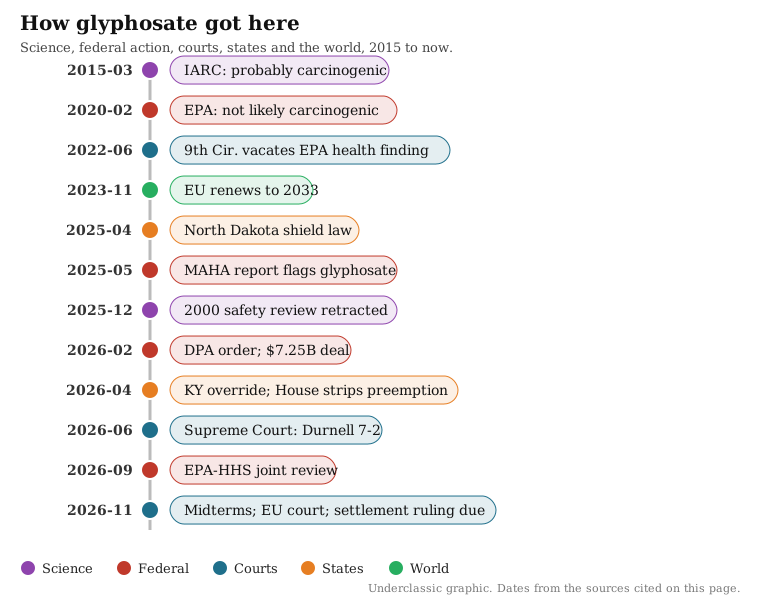
EPA's 2020 interim decision found glyphosate "unlikely to be a human carcinogen." In June 2022 the Ninth Circuit vacated the human-health portion of that decision, and EPA withdrew it in September 2022 while keeping its longstanding cancer finding. A new human-health and cancer assessment is expected in early 2027, informed by the joint EPA-HHS review announced in September.
Sources: EPA glyphosate page; Ninth Circuit opinion, June 17 2022 (PDF); EPA-HHS release, Sept 23 2026
The courts: Durnell and the settlement
| Date | Case | Status |
|---|---|---|
| 2026-11-04 | Antidote Europe v. Commission (EU General Court) EU approval to December 2033 stands; appeal on points of law possible. Sources: Courthouse News | Dismissed |
| 2026-11-03 | $7.25 billion class settlement (St. Louis, Judge Timothy Boyer) Preliminary approval Mar 4; opt-out deadline June 4; fairness hearing Sept 14. Paid in declining annual installments for up to 21 years. Opt-outs may keep suing; appeals could take years. Sources: Bayer Q3 2026 legal risks; Reuters via Claims Journal | Awaiting final approval |
| 2026-10-29 | Aretino v. Monsanto (St. Louis County) First jury verdict after Durnell; jurors rejected design-defect, negligence and fraud claims. Sources: Husch Blackwell | Defense verdict |
| 2026-06-25 | Monsanto v. Durnell Justice Kavanaugh wrote that FIFRA expressly preempts state failure-to-warn claims that would force a cancer warning onto the EPA-approved label. The Court did not decide whether glyphosate causes cancer; design-defect and negligence claims survive. Sources: Supreme Court opinion (PDF); SCOTUSblog | Decided 7-2 for Monsanto |
The statehouses: who shielded the label and who refused
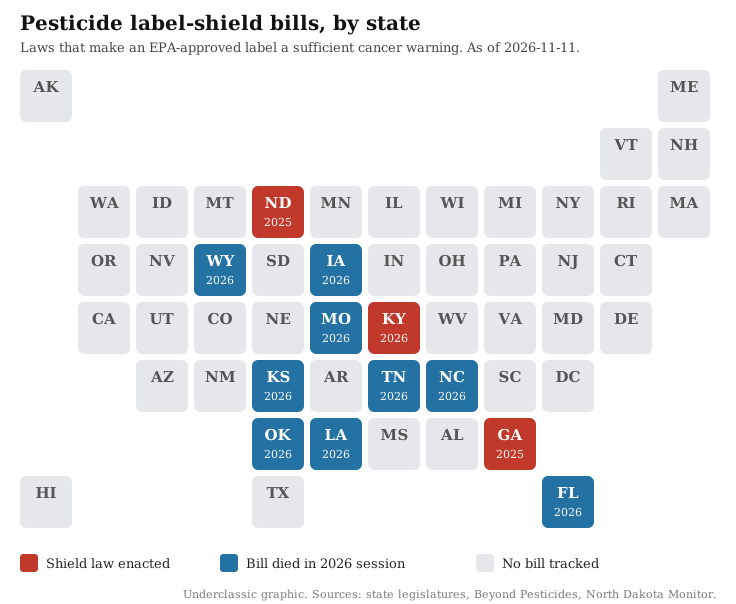
Before the Supreme Court ruled, Bayer and farm groups pushed state bills making an EPA-approved label a sufficient cancer warning. Three states passed one. At least nine bills died in 2026, several in farm states. After Durnell, plaintiffs' lawyers argue the state bills matter less, because the Court applied the same rule nationwide to failure-to-warn claims.
| State | Bill | Status | Notes and sources |
|---|---|---|---|
| North Dakota | HB 1318 | Enacted (2025) | First state law making an EPA-approved label a sufficient warning; signed April 2025. North Dakota Monitor |
| Georgia | SB 144 | Enacted (2025) | EPA-approved label deemed sufficient from Jan 1, 2026, unless EPA finds the maker concealed health data. O.C.G.A. 2-7-171 |
| Kentucky | SB 199 | Enacted (2026) | Gov. Beshear vetoed it; the Senate (24-12) and House (56-32) overrode him on Mar 31 and Apr 1. Kentucky legislature record; Kentucky Lantern |
| Iowa | SF 394 | Failed (2026) | Passed the Senate 26-21 in March 2025; died in House Judiciary when the 2026 session ended. Iowa Legislature: SF 394; Beyond Pesticides bill tracker |
| Missouri | SB 1005 / HB 2712 | Failed (2026) | Third straight year of failure in Bayer's U.S. headquarters state. MO Bill Watch: SB 1005 |
| Kansas | HB 2476 | Failed (2026) | Passed the House 81-36; tabled in Senate committee after the attorney general's office cited the pending Supreme Court case. Wisner Baum summary |
| Florida | HB 443 / SB 518 | Failed (2026) | Died in committee. Beyond Pesticides bill tracker |
| Tennessee | HB 809 / SB 527 | Failed (2026) | Pulled from the House Judiciary calendar. Beyond Pesticides bill tracker |
| Louisiana | HB 1158 | Failed (2026) | Did not leave committee. Beyond Pesticides bill tracker |
| Oklahoma | HB 1755 / SB 1078 | Failed (2026) | Session ended without a floor vote. Beyond Pesticides bill tracker |
| North Carolina | S 639, Sec. 19 | Failed (2026) | Dropped from the final Farm Act in conference. Beyond Pesticides bill tracker |
| Wyoming | SF 74 | Failed (2026) | Not introduced on the Senate floor before the deadline. Beyond Pesticides bill tracker |
Iowa: high cancer rates, a nitrate problem, and an open question on pesticides

Iowa has the second-highest cancer incidence in the country and is one of the few states where rates are still rising, according to the Iowa Cancer Registry, which estimates 21,700 new cases and 6,400 deaths in 2026. Young adults aged 20 to 39 have the second-highest cancer rate of their age group nationally.
A Nov 9, 2026 American Cancer Society study found Iowa's incidence rising about 0.6 percent a year while seven neighboring states held steady, driven mostly by early-stage prostate and breast cancers; its authors said that fits increased screening best, but they had no data on environmental exposures and called for study of farm exposures and radon.
The registry's director, Mary Charlton, says the causes are unclear. Its 2026 report, built on the Agricultural Health Study, found that Iowa farmers had 13 percent fewer cancers overall than other Iowans but more prostate and lip cancer, and their spouses more melanoma and thyroid cancer. The largest study of glyphosate users within that cohort, published in 2018, found no association with non-Hodgkin lymphoma.
Iowa's documented water problem is mainly nitrate from fertilizer and manure, not glyphosate. A U.S. Geological Survey sampling of Iowa public-supply wells found no glyphosate in any well sampled in 2013, and its breakdown product AMPA in only two of 60 wells, at trace levels. The Iowa Environmental Council and Drake University's Harkin Institute, in a March 2026 review, linked Iowa's cancer burden to nitrate, radon, PFAS and pesticides including glyphosate, acetochlor and atrazine; that report is an advocacy-group literature review, not a new causal study.
Politically, Iowa's liability-shield bill passed the Senate in 2025 and then died in the House in 2026. A state-funded University of Iowa study of cancer drivers is about a quarter complete and plans to add environmental factors in later phases.
The state's MAHA moment also ran through its governor's race: Zach Lahn, the Republican nominee backed by nearly $2 million from MAHA-affiliated groups, lost on Nov 3.
Sources: Iowa Cancer Registry, 2026 report; Iowa Public Radio, Mar 13 2026; Andreotti et al., JNCI 2018; USGS 2013 survey of Iowa groundwater; Iowa Environmental Council / Harkin Institute, Mar 25 2026; The 19th, Nov 2026; KCRG on the ACS study, Nov 9 2026
The health evidence, graded
We grade each claim by what the cited research can support. "Documented" means a matter of record; "Contested" means credible bodies disagree; the weaker labels mean the evidence is thin, indirect or mainly from animals.
| Question | Strength | What the evidence shows |
|---|---|---|
| Non-Hodgkin lymphoma and cancer | Contested | IARC classed glyphosate "probably carcinogenic" (Group 2A) in 2015 on limited human evidence and sufficient animal evidence. EPA and European regulators concluded a cancer classification was not warranted. The Agricultural Health Study (2018) found no NHL link; a 2019 meta-analysis found a 41 percent higher NHL risk at the highest exposures. Juries have ruled both ways. Sources: IARC Monograph 112 (PDF); Andreotti et al. 2018; Zhang et al. 2019; Courthouse News on EU regulators |
| Ghostwritten safety review | Documented | Regulatory Toxicology and Pharmacology retracted the widely cited 2000 Williams, Kroes and Munro review in December 2025, citing apparent Monsanto ghostwriting and undisclosed conflicts. Sources: Retraction Watch, Dec 4 2025; The Guardian, Dec 5 2025 |
| 2025 Ramazzini rat study | Single study, disputed | The Ramazzini Institute reported more benign and malignant tumors, including leukemia, in rats exposed from before birth to doses from 0.5 mg/kg per day. Germany's BfR said the study does not refute earlier long-term studies and needs the raw data released. Sources: Panzacchi et al., Environmental Health 2025; BfR assessment |
| ADHD and child development | Weak, unresolved | No study shows that glyphosate causes ADHD. A small 2002 Minnesota study of pesticide applicators' children found more parent-reported neurobehavioral problems, a category that included ADHD, with glyphosate use (odds ratio 3.6). A Puerto Rico cohort of 143 mother-child pairs linked prenatal exposure to lower communication scores at 12 and 24 months. A 2025 Canadian pregnancy cohort reported no significant association with cognitive or behavioral scores. Sources: Garry et al., EHP 2002; PROTECT-CRECE, Environ Res 2024; MIREC Canadian cohort, Environment International 2025 |
| Hormones | Limited | A 2025 analysis of 1,532 NHANES participants linked higher urinary glyphosate to lower estradiol, progesterone and other sex hormones. The data are cross-sectional and cannot show cause. Sources: NHANES 2017-18 analysis, 2025; Thyroid review, 2025 |
| Gut microbiome | Mostly animal evidence | Reviews report dysbiosis and gut-barrier changes in animal studies. Human evidence is thin. Sources: Archives of Toxicology review, 2025 |
| Pregnancy and preterm birth | Limited, observational | A 2026 NYU cohort of 1,450 New York City pregnancies linked higher mid-pregnancy urinary glyphosate to preterm birth (odds ratio 1.35) and spontaneous preterm birth (odds ratio 2.01). Early-pregnancy levels showed no link, and one cohort cannot show cause. |
Beyond Washington
| Where | Status | Notes and sources |
|---|---|---|
| European Union | Approved to Dec 2033 | Renewed in November 2023 after member states twice failed to reach a qualified majority; upheld by the General Court on Nov 4, 2026. On Nov 9, 2026, ECHA's risk committee said the Ramazzini study does not justify a cancer classification; EFSA's view is due by July 2027. European Commission; EFSA glyphosate page |
| Mexico | No ban in force | The 2020 decree's phase-out was reversed; a Senate ban proposal was shelved in March 2026 over the USMCA trade review. Excelsior (Spanish); Opportimes |
| United Kingdom | Re-approval decision due late 2026 | A HortWeek survey found about 95 percent of councils still use glyphosate. Sheffield approved a 20-street opt-out trial on Nov 6, 2026. No-Till Farmer roundup, Nov 3 2026; Sheffield City Council |
| Local U.S. control | Varies by state | Seven states (Maine, Alaska, Hawaii, Maryland, Utah, Nevada and Vermont) let towns regulate pesticide use; most others preempt local rules. Rep. Pingree |
What to watch
- Judge Boyer's final-approval ruling on the $7.25 billion settlement (Bayer says before Christmas).
- EPA comment deadline Nov 23 on the glyphosate literature search; human-health assessment due early 2027.
- Whether a lame-duck farm bill keeps the five-year delay in pesticide re-review.
- Any USDA order issued under the Defense Production Act delegation, which would be the first test of the Section 707 immunity clause.
- 2027 statehouse sessions: whether shield bills return in Iowa, Missouri and Kansas now that Durnell covers failure-to-warn claims nationally.
- Wisconsin health officials' recommended groundwater limits for glyphosate and 21 other pesticides (due November 2026); EFSA's review of the Ramazzini study (by July 2027).
How this tracker is kept
Underclassic updates this page from site/glyphosate.json. New items are added to the Latest column with a date and a link; older items are corrected, not erased. Claims by advocacy groups, plaintiffs' lawyers and Bayer are attributed to them. Related reading: Data centers on the ballot / What the midterms turned on / Page 3.