Underclassic rss archive buyer's guide
Permanent copy of issue 83. Today's issue is always the front page.
Previous issue | This week | Next issue | archive
Google said on Thursday it will pay for 1,070 megawatts of new demand reduction from homes and businesses on the PJM grid, a tenfold expansion of its June agreement with Voltus, as data centers strain the largest power market in the United States. The same day Bloom Energy reported revenue up 138 percent on sales of on-site fuel cells to data center builders, and Nvidia has committed advance payments to secure packaging, substrate and test capacity for its chips. On the local side, MiniMax published downloadable weights for a 428-billion-parameter model.
Date: 2026-10-24
Updated: 2026-10-24 06:30
Status: LIVE
Broadcast
The power shortage is changing who pays and who gets paid. Google will now send money to households and shops in thirteen states for switching off at the right moment, which is faster than waiting for a new plant. Bloom's customers are taking the other route and building their own supply behind the fence. Both keep the data centers running without waiting for new plants or lines. MiniMax's release is a reminder that a capable model can still leave the cluster, provided someone has the hardware to receive it.
Watch
Stories
Google and Voltus said on Thursday they will add 1,070 megawatts to the 100-megawatt virtual power plant they agreed in June across PJM, the grid that serves 67 million people in 13 states and Washington, D.C. Voltus will pay homes and businesses to cut their use with batteries, thermostats and factory adjustments when the grid is strained, and Google will fund the program.
-- One of the largest buyers of electricity is paying ordinary customers to use less rather than waiting years for new plants and lines. Demand cuts at that scale help the grid through its peaks, but they do not add the round-the-clock generation a data center consumes.
2026-10-22 / Voltus / energy / mixed / #google-funds-a-one-gigawatt-virtual-power-plant-
Bloom Energy reported third-quarter revenue of $1.24 billion, up 138 percent from a year earlier, and raised its 2026 forecast to between $4.4 billion and $4.6 billion. Chief executive KR Sridhar told analysts on Thursday that the first block of fuel-cell power is ready at Nebius's 300-megawatt New Jersey data center, about five months after the contract was signed.
-- Data center builders who cannot wait years for a grid connection are paying to generate electricity on their own sites. That shortens the clusters' path to power and moves a growing share of their supply outside the public grid.
2026-10-22 / Bloom Energy Investor Relations / energy / central / #bloom-energy-more-than-doubles-revenue-as-data-c
Nvidia said at its Berlin conference that agreements with IBIDEN, Samsung Electro-Mechanics and Unimicron will raise substrate capacity for its chips 2.5 times over three years, and that Amkor plans to lift its advanced packaging capacity by more than 300 percent by the end of 2028. Nvidia is also advancing $1.1 billion to King Yuan Electronics to build test plants in the United States, and Amkor said its multi-year agreements with Nvidia now total $3 billion.
-- The limit on AI accelerator output now sits in the packaging, substrates and testing around the silicon, and Nvidia is using its cash to reserve that capacity. That keeps the largest supplier of cluster chips first in line for the parts every rival also needs.
2026-10-21 / NVIDIA Investor Relations / chip / central / #nvidia-pays-suppliers-in-advance-to-multiply-its
MiniMax has posted MiniMax-M3.1-Flash on Hugging Face, a 428-billion-parameter model that activates about 23 billion parameters per token and accepts text, images and video with a context of up to one million tokens. The files total about 252 gigabytes and come under a community licence that is free for non-commercial use but requires written permission for products earning more than $20 million a year.
-- A model that matches leading closed systems on several of the company's published coding tests can now be downloaded and run on hardware its user controls. At 252 gigabytes it still needs a server or a large workstation rather than a laptop, but it takes the meter off a model of that class.
2026-10-23 / Hugging Face (MiniMax) / efficiency / local / #minimax-publishes-the-weights-of-its-fastest-mod
Axis
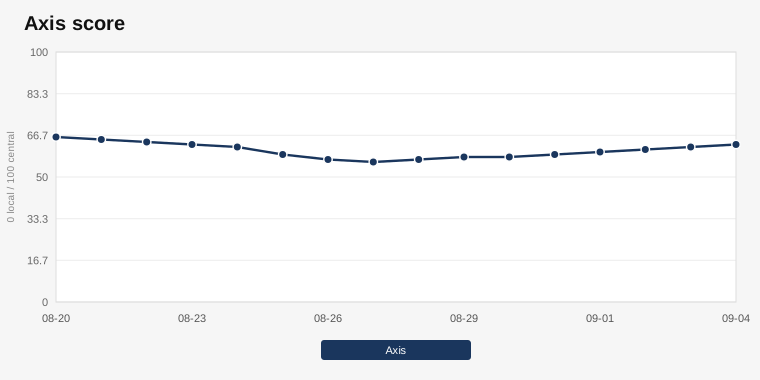
local [#########################-----] central
Score: 82
clusters still winning
up 1
The clusters spent the week buying what they cannot wait for: Nvidia reserved packaging and test capacity, and Bloom's fuel cells are powering data centers that the grid cannot yet serve. Google's virtual power plant spreads some of that load onto homes and businesses, and MiniMax's open weights give a large model to anyone with a server, but neither changes who holds the capacity, so the score rises to 82.
Forces
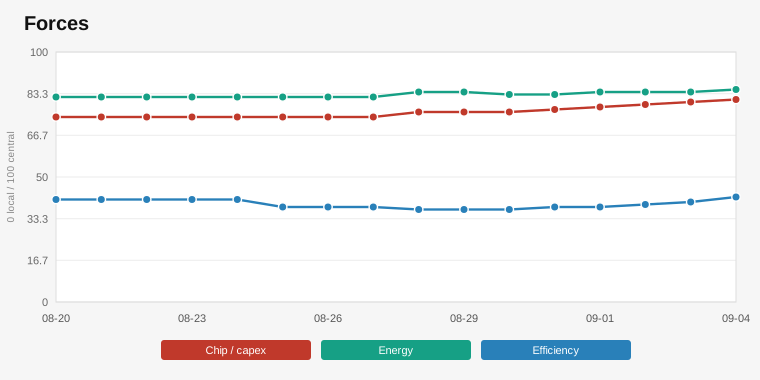
| Force | Meter | Score | Pull | Note | ||
| CHIP / CAPEX |
|
96 | central | Nvidia set substrate capacity for its chips to rise 2.5 times over three years, Amkor plans to more than triple its advanced packaging capacity by the end of 2028, and Nvidia is advancing $1.1 billion to KYEC for U.S. test plants. | ||
| ENERGY |
|
98 | central | Google is funding 1,070 megawatts of additional demand reduction across PJM through Voltus, and Bloom Energy reported quarterly revenue of $1.24 billion, up 138 percent, from on-site power that lets data centers start before the grid can serve them. | ||
| EFFICIENCY |
|
71 | mixed | MiniMax-M3.1-Flash activates about 23 billion of its 428 billion parameters per token and was trained to run at reduced precision, but its 252-gigabyte download still needs a server-class machine. |
Line charts (0=local 100=central 2026-10-07 to 2026-10-24)
Market overlay (2026-09-25 to 2026-10-24)
Latest: BTC $80,495 / hashrate ~1067.99 EH/s / token markers avg $5.2583/M / axis 82. These lines are different units. We compare timing, not dollars-to-hashrate.
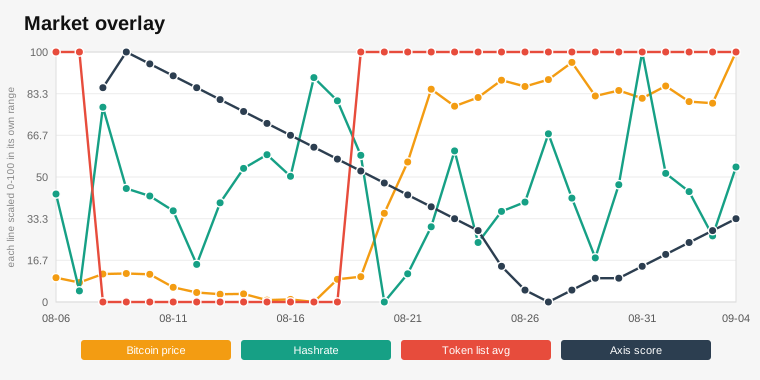
Not shown: GPU cloud $/hour, hub electricity, miner hashprice, or lab cost per token -- none of those are a clean public feed.
Power and list prices
BTC $80,495 / hashrate ~1068 EH/s. List-price gap (not a subsidy %): 123.1x list gap (blended) Mercury 3 -> Claude Fable 5.1 ($0.16/M to $20.00/M). (mempool.space + Coinbase/CoinGecko)
Marker prices (USD per 1M tokens; verified 2026-10-22; blended = (3*input + 1*output) / 4; -- = open/self-host or no single public list)
| # | Model | Org | CC | Weights | Tier | In | Out | Blend |
| 1 | Claude Sonnet 5 | Anthropic | US | closed undisclosed |
workhorse | $2.00 | $10.00 | $4.00 |
| 2 | GPT-5.5 | OpenAI | US | closed undisclosed |
flagship | $5.00 | $30.00 | $11.25 |
| 3 | DeepSeek V4.1 Flash | DeepSeek | CN | open ~284B total / ~13B active (MoE) |
commodity | $0.30 | $1.20 | $0.53 |
If useful, support the broadcast.
bc1qfs3yw5qlq8sxs50crzh3g84ug27gvww9npu85n

Subscribe
$ echo you@email.com | underclassic --subscribe
One email per issue. No tracking pixels, no filler.
home | rss | page 2 | page 3 | archive | models | buyer's guide | subscribe | data | board | mcp | llms.txt